Contact
Write to me
If you have a question, an idea, an invitation to speak, or just a few words after reading.
The world is better than they say. I’ll show you.
The world is better than they say. I’ll show you.
I woke up from the chatter of little monkeys jumping in the trees above me. They are very cute creatures. I think they were looking for fruit or flowers. It was drizzling, but the mighty deciduous tree above me sheltered me from most of it, with only the occasional particularly persistent drop making it through the hammock net. The first rays of dawn were shining through the reeds. It was time to get up.
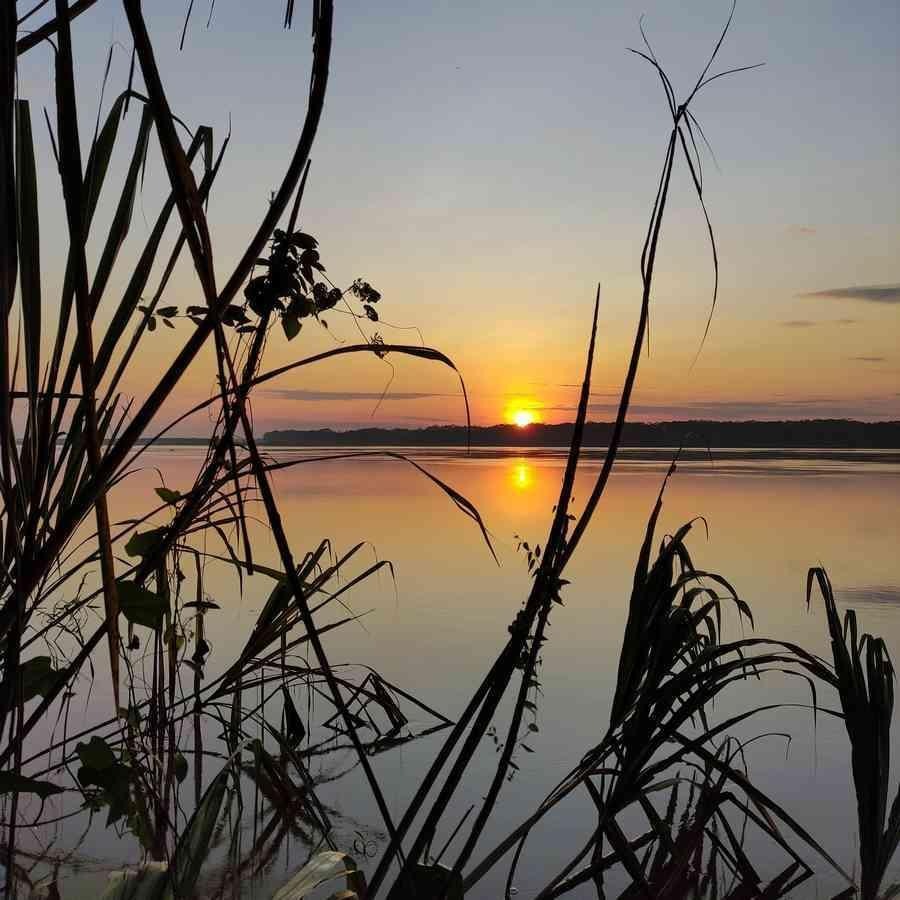
While I was packing, I found a huge spider in one of my bags. I could hardly chase it away. I do not need passengers yet; it is hard enough to sort myself out. I filled the empty boat with water to wash away the dirt and the minor colony of ants that had managed to make themselves at home overnight. The mosquitoes on the bank are annoying, but order and cleanliness are worth a few bites. I wonder that creams and sprays do not help much against the mosquitos.
I have run out of water. All the eight litres of bottled water that I took with me are gone. There have been no settlements on the way; apparently, they are hidden deeper in the forest. I took some water from the river, let the sand settle down, poured the water through the towel into another bottle, and then poured it through the filter into yet another bottle (the filter is attached to the bottleneck). This way, hopefully, I can prolong the filter’s service. Filtering takes a long time, but one cannot go anywhere without water. So, in the end I cooked some farinha with the water right from the Amazon. If this experiment earns me no diarrhea, one of my key issues will be taken off my survival agenda.
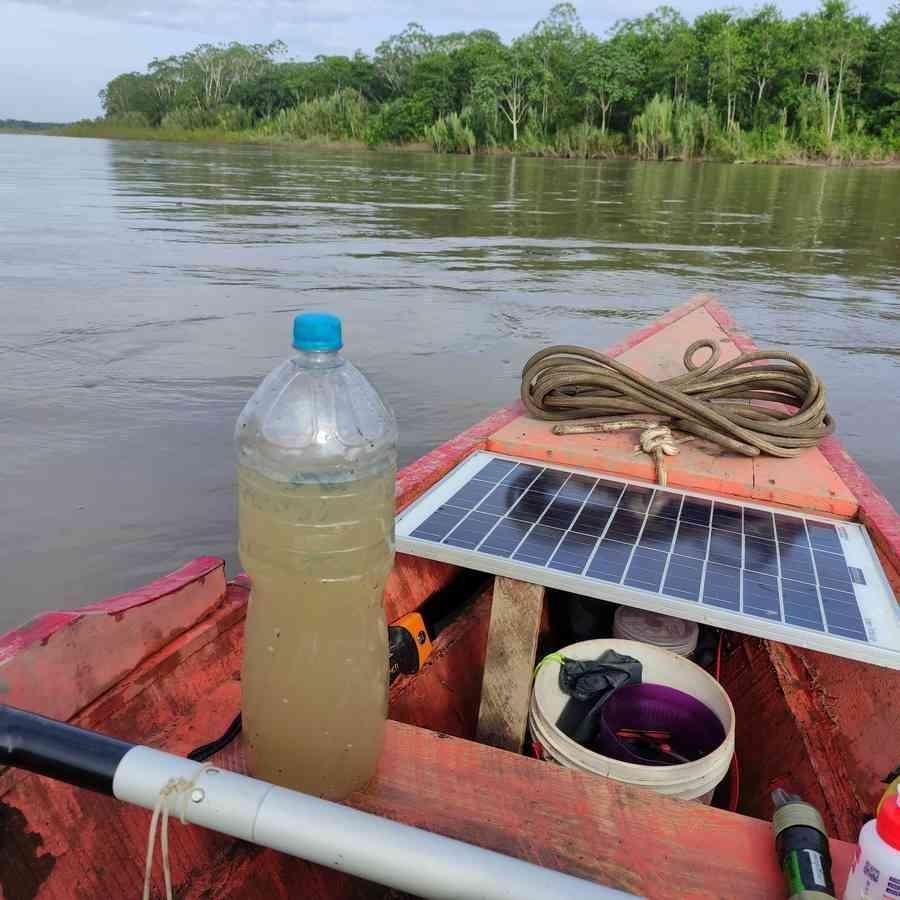
Here it is, the first village on the horizon – in the five days! I am not sure I can make it there, though. The current is too strong.
I run out of energy halfway through, and the current only gets stronger as I approach the bank. I need to talk to the locals, so I paddle desperately towards the village for a while longer, and I dock with my hands shaking. I can see a communications tower and some hangars, a school and even some solar panels!
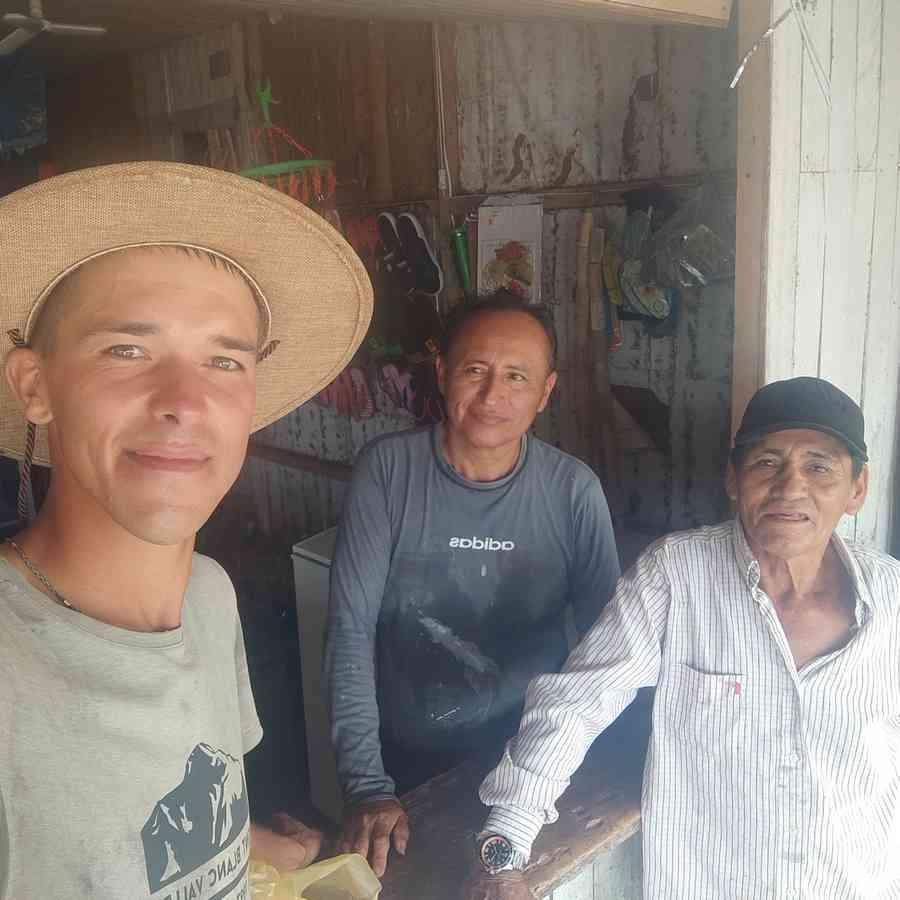
On the bank, I was met by a man. In a nutshell, he was very surprised. I explained that I needed to replenish my water supply or buy a bigger tank. Then I was taken to the local shop. There I met Marda and Fidel (of course there were jokes about Fidel Castro), bought a few bottles of water, as 8 litres of containers were clearly not enough. I talked to the owner of the shop to find out what they fish with and what kind of tackle they use. He showed me a nylon thread and some huge hooks. Wow. All right then. And what is the bait? That is where it all became clear. The soil near the river is very poor indeed, there are almost no worms in it. The locals get them in the villages or use small pieces of chicken meat instead. I was reassured that down the river there will be uplands and black soil, where both fish and insects will be easier to find. Hopefully, the insects will not turn out to be some bloodsucking type. I decided to be extravagant and spent some of my carefully rationed money on a long nylon string. It will come in handy not only for fishing, but also in my everyday life. I said goodbye to the locals and set off.
At the confluence of the channel into the river I came across dolphins again – and a lot of them! There were at least eight dolphins jumping out of the water in pairs now and then. There were also a lot of birds soaring in the sky. I think there must be plenty of fish here. According to the map, there is a lake nearby, and I could get there through one of the river channels, but I decided against stopping for now. Now it is important to organise my life, to build a tent on the boat and only after that I should spend this precious time on fishing. Also, it will start to rain at any moment.
I also was thinking about my sleeping arrangements. True, sleeping in the jungle in a hammock is very comfortable, the sleep is much healthier, but too much effort is spent to get to a convenient place through the thickets and to pull all the things on the bank. If I do my honest calculations, it will take me about 70 days to get to Manaus, the capital of the Brazilian Amazon, more than 3000 kilometres down the river. That is, if my health permits taking the full trip. That means unloading and loading the boat 70 times, setting up camp, fighting off mosquitoes. A better idea would be to equip the boat for a full day cycle, although this decision has its own drawbacks. It is still unclear how much water it takes on… and what else might suddenly become a problem.
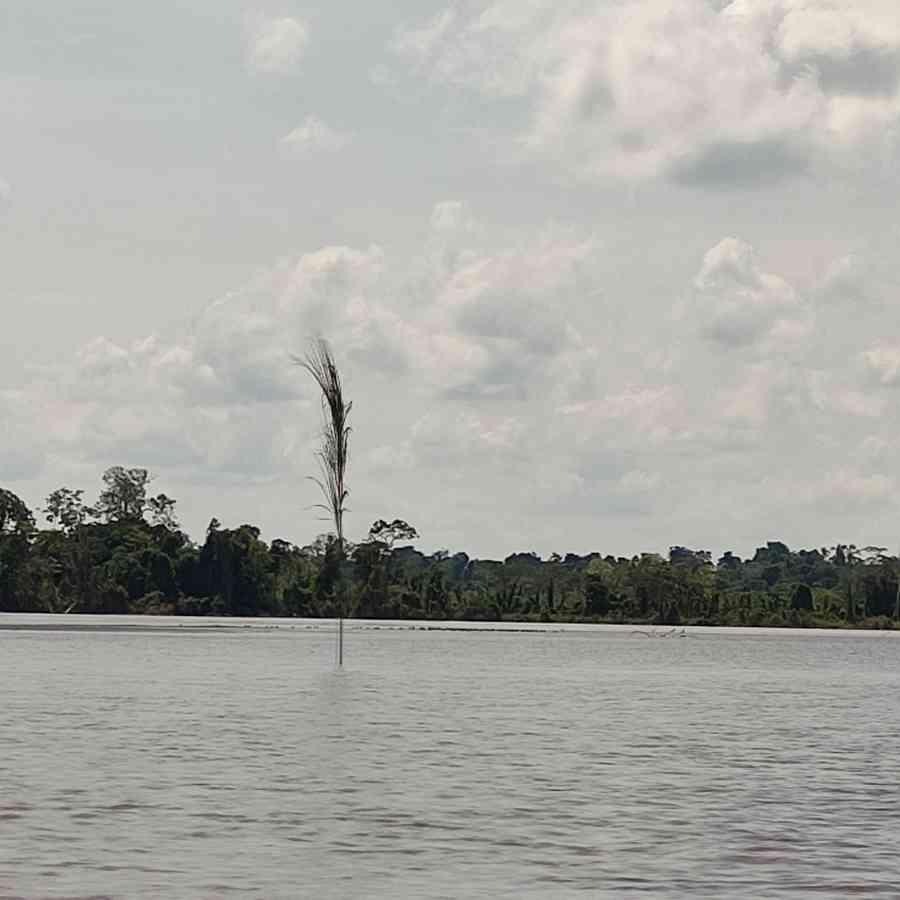
I went ashore to look for materials for the tent. I settled on reeds, which grow all over the freshly formed banks. Reeds may not be too strong, but they are light enough that the tent will not shift the canoe’s centre of gravity. It is nice to feel much more confident in the jungle than I did the first few times. I am no longer a stranger. At least I feel much more at ease, like I am a welcome guest.
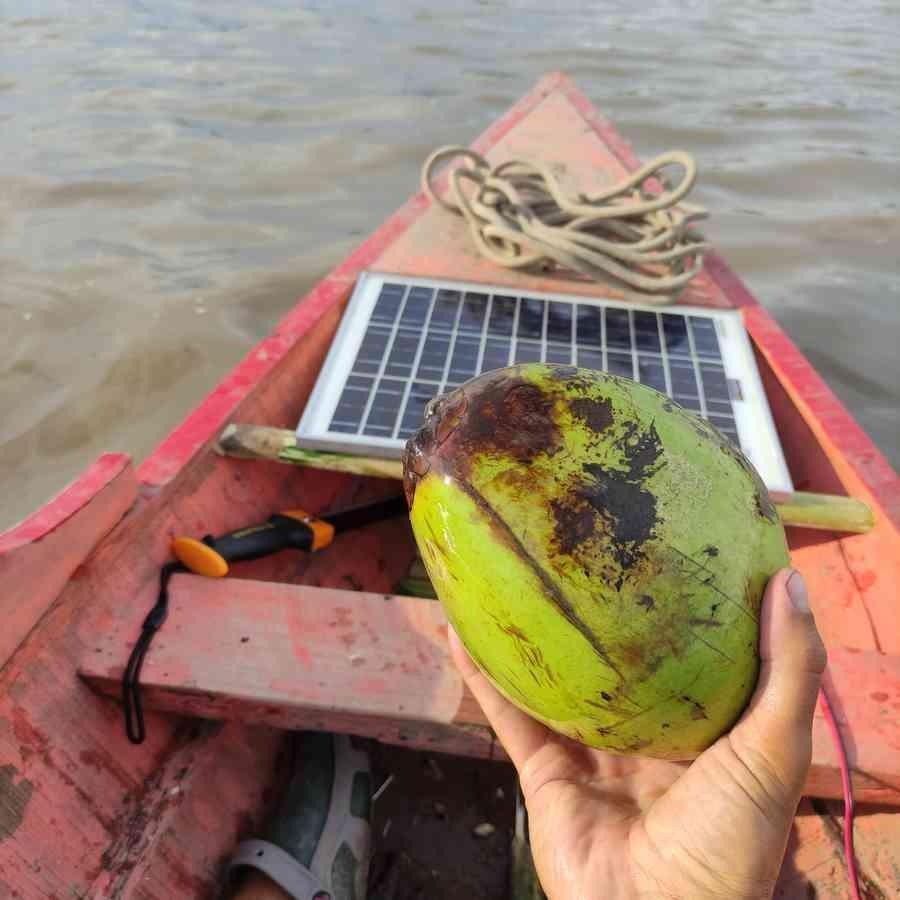
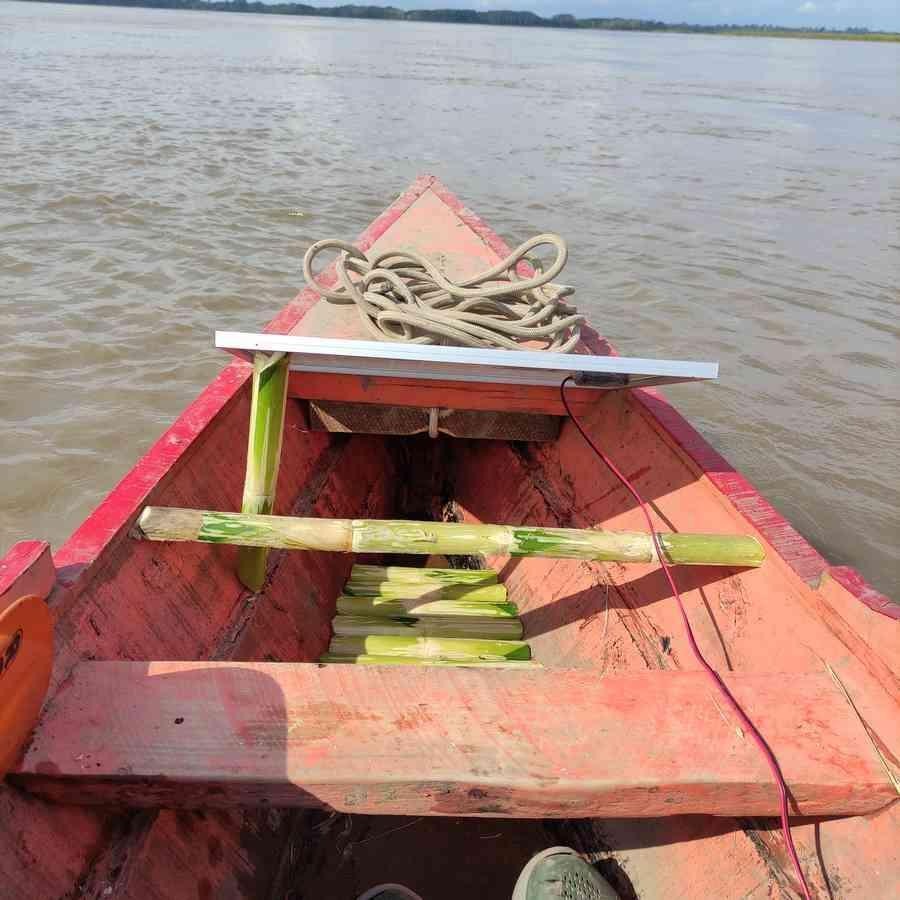
With a machete, I made a groove for the solar panel on the bow of the canoe. Now it is more like a lid that covers the storage compartment, and it can be angled to the sun if necessary. The solar panel is 20W, so it has enough power to charge a phone for filming on the road. If it rains, the water will roll down it past the bag of supplies hidden underneath. The fishing gear is under it as well.
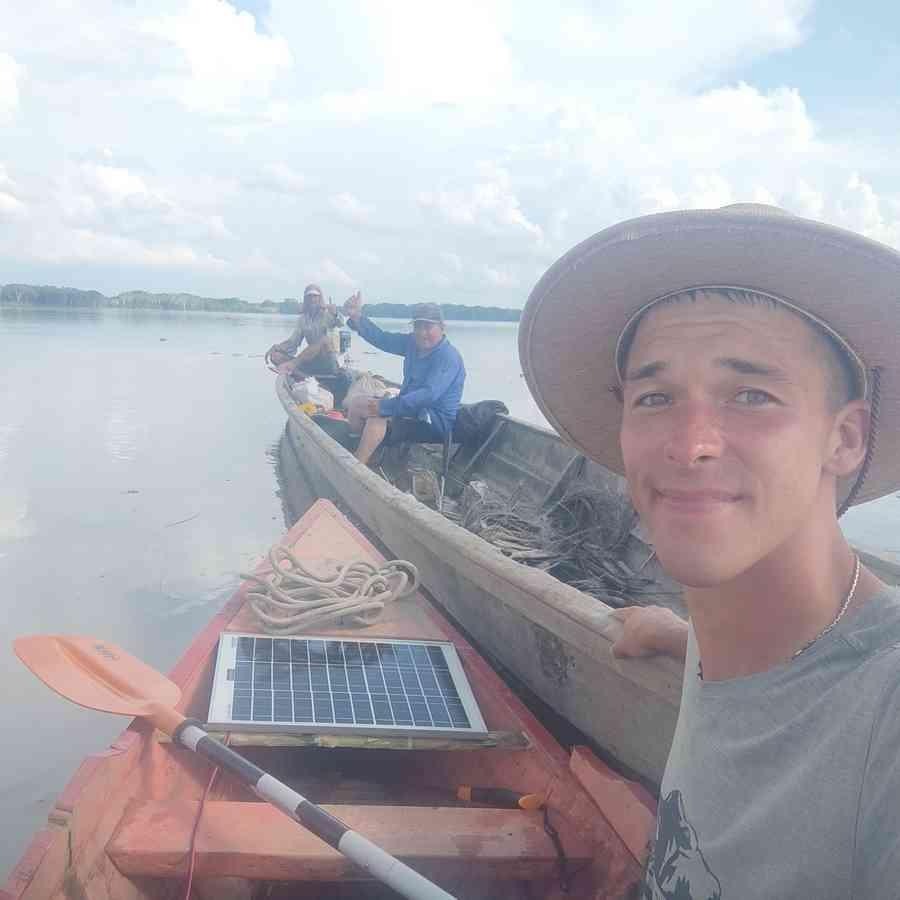
I had my first encounter with locals on the water. Peter and his friend approached me on their motorboat. At first, I was a bit scared, as they looked like bandits, to say the least, but they were very friendly and open. If they are indeed pirates, they chose not to behave like pirates this time. They wished me a happy journey.
I passed a banana plantation and a house that was half-hanging over the water. Now I understand why many villages are built deep in the jungle – this way they are protected from the whims of the river. I do not know how much exactly the water rises during the wet season, but it was clearly more than 5-7 metres. It is great that I am not fighting the current but going with it.
Wow! I fished a real coconut out of the water, right in the middle of the river! And it is a whole one. That is quite a miracle, as they rot quickly in water. It must have fallen into the river not so long ago. The day is just getting better. I will save the coconut for the worst day. Will it be tomorrow? I do not really know. I am really hungry.
The thunder rumbles once again and a rainbow appears on the horizon. It is time to dock. Or is it? The sun is setting. I think it is time. I do not want to look for a good place to set up camp in the middle of the night, as I did yesterday, and the day before… as usual, I guess. Today my equipment is more orderly organised in the boat, so that makes me happy.
Parking this boat is an art. To pull its bow onto the bank (it’s too heavy to pull all the way out), I let it go with the current on the rope and then start pulling with force. The boat picks up speed, crashes into the bank, and I tie it to the nearest tree. This time I pulled it harder and higher, so that in case some barge passed by, I would not be unanchored and flooded with water.
The rainclouds are getting closer. There was no time left to finish the reeds for the bed, so I threw them into the boat lengthwise. Sleeping on them will be uncomfortable, but there is no other option yet. I set up the hammock, threw the tent over it, and climbed inside. I am sleeping right on the river again. This place is deep, and it is a little scary. I have slept in a boat before, but it is not a thing you can get used to. What if it takes on more water during the night? I must try anyway, otherwise this fear will haunt me forever and the quality of my life on this trip will stay very low.
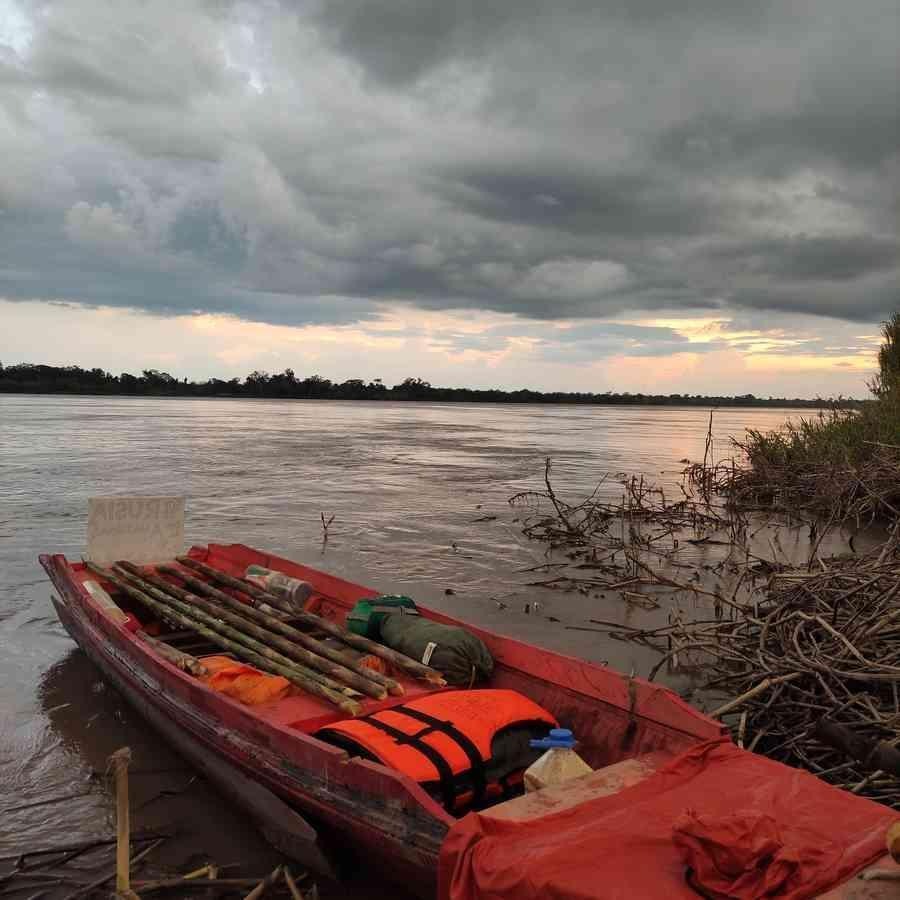
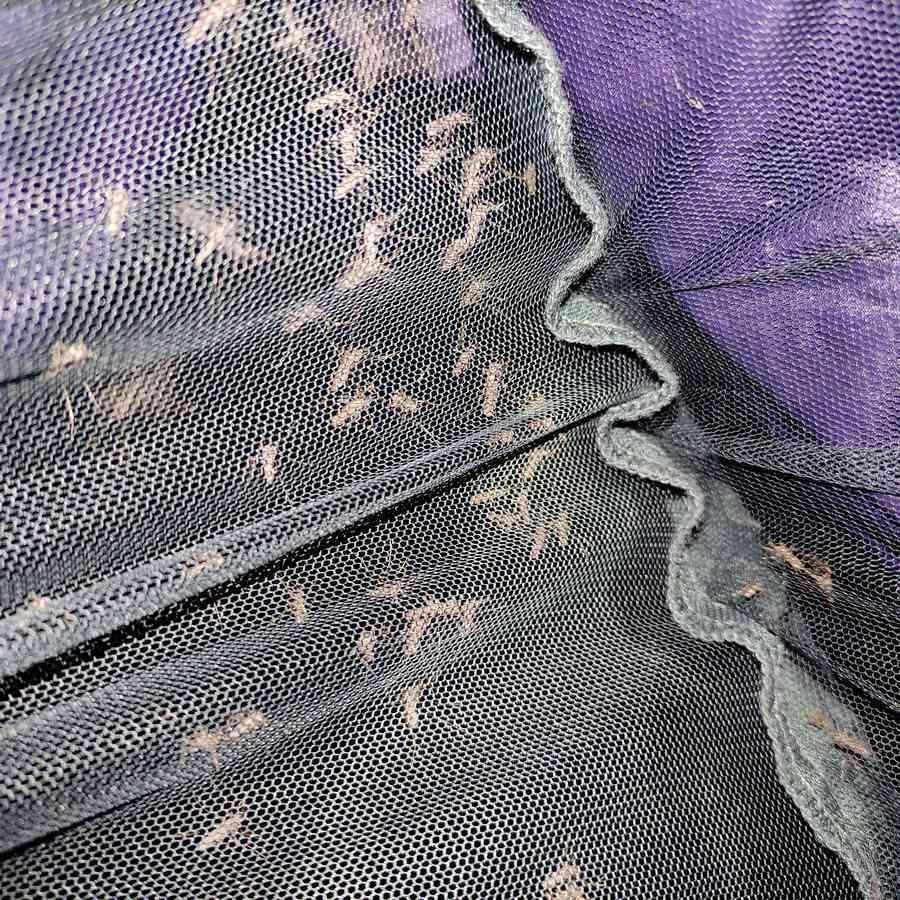
It started raining. I hid as best as I could. The hammock is not stretched out tight enough, the cover is right up against my body. I can feel the heavy cold drops hitting me directly. It would be all right, but the rain also presses the mosquito net to the cover, so the mosquitoes, which had piled up under the upper tent in hordes, are able to bite me with impunity. They try to get into every little hole, little pests.
Every minute it becomes harder for me to breathe under the hammock cover. It is stifling. I need to think up a construction of some frame to avoid repeating this unpleasant experience.
I make a small window to breathe and watch what is going on, but as a result I get the feeling that I am the one being watched. Hundreds of bloodsuckers are waiting for me to come out and share my life-giving fluid with them. I think the call of nature will have to wait until the morning.
I woke up in the middle of the night to a bright light by my boat. A large ship was speeding upstream, very close to me. It was dragging a barge behind it, and on the barge there was a coffin-like thing with candles and a huge cross. It looked creepy as I was startled awake. Was it a funeral procession of some sort? I have no idea. After that, the waves got to me. That is when I felt the real fear. My boat was bobbing like a splinter on the waters – left and right, and some of the waves were tickling my heels, pouring over the side. It was a good decision to pull the bow ashore! It could have been a disaster.
Well, that is experience, too. Now I know that my boat can handle the attempts to bury me. I feel better. It did not help me to fall asleep fast, though. No, sleeping in the main channel of such a big river was a bad idea after all.
19 April, ~58 (185) km covered.


