Contact
Write to me
If you have a question, an idea, an invitation to speak, or just a few words after reading.
The world is better than they say. I’ll show you.
The world is better than they say. I’ll show you.
I woke up alive, which is always a good beginning of the day. I pulled at the doorknob, and the door opened. I was free. Everyone in the house was still asleep, so I set about unloading the boat to the sound of roosters’ crowing. Christian, whose house happened to be across the street, and Hai met me at the pier. They thought I had decided to set out, even though I had been warned against it. I assured them that I would not have broken their trust that way.
I altered my plans as follows: I need to sell some of the gear I have. One thing to sell is my tarafa net, for example, which the pirates had miraculously disregarded. Then I would take a small ship back to Coari, then board a large ship which will take me to Manaus. This is not the ending that I had wanted, but it is some experience too. At least I will learn how to survive on the Amazon in a hammock on board like regular tourists do. It will also give me a couple of days to reflect on my trip. I have seen so much on this river that I will not be surprised even at the sight of pirates paddling in a boat, so I do not think this shortcut will cost me new impressions. It is more likely that it will allow me to keep my already acquired impressions and deliver them to safety.
Aside from items for sale, I sorted out my belongings into the things that are especially dear to me and into the things I could give as gifts. The local kids were extremely excited to see my fishing tackle, especially all kinds of wobblers, poppers, and rubber fish, that I gave them almost immediately: five little fish to five children. I also showed them some tricks with my firebrand, kindling a fire. I played some tunes on my vargan. They looked at me with such excitement as if I were a magician, who could fly into the air if he wanted.
My newest discovery was a plant called ‘maufa’ by the locals. I noticed a man going into the water up to his waist and pulling out some branches. He was pulling thin thread-like sprouts from them. It turned out that this material is used to make clothes here. They soak the branches in the water for a week or two and then cut the threads. That is interesting. Now I understand what was drying on the racks outside the houses. These were hundreds of kilos of weaving material.
While that smiling man who was gathering maufa was telling me about the intricacies of its harvesting, I noticed that his boots were literally torn, with toes sticking out. How does he still wear them? With his job, this is a vital thing. I gave my boots to him as a gift. Despite their large size, he accepted the gift with gratitude.
For several times, I was invited to different houses for coffee. It is interesting that they drink it very sweet. I have been eating farinha with sugar for two months, but my taste buds were in shock at how sweet the local coffee was.
Once again, I asked why people were so friendly in some parts of the river and completely ignored me in other places. The answer was the same: there are open communities and then there are closed communities. Some make money from drugs and avoid any prying eyes, while others live by honest labour, growing farinha, for example, or harvesting maufa for sewing.
Childhood and youth look very different here. Here was a young lad, about 15-18 years old, chopping greenery from banana trees with a machete before my eyes, and an hour or two later he was running around with a kite made of branches and a bag with Nike logo. Other kids had other brands. Apparently, the logos are ‘cool’.
Breakfast turned out to be a surprise. Not as surprising as monkey soup, fortunately, but… it included pancakes – in the Amazon jungle! The pancakes were served with some kind of jam – guarana, I guess. That is a local fruit, which grows aplenty here.
I gave out my leftover postcards as souvenirs. I find it interesting that Ebakurau chose Greece, the photo that showed the White Tower in Thessaloniki, an ancient structure of the XV-XVI century, while all the kids picked cards with photos of nature. They especially liked the Charyn Canyon in Kazakhstan. I wrote good wishes to everyone as a souvenir, leaving my contact info on the cards.
At first, it was hard for me to accept such a rapid change of plans. But after spending a day in this peaceful community, I was able to put my thoughts in order. Everything fell into place. It looked like I had won my biggest prize called ‘Life’.
I wish I could take just one shot, as I usually do, to remember the details of the moment, but I do not have a camera. All that is left is for me to draw it.
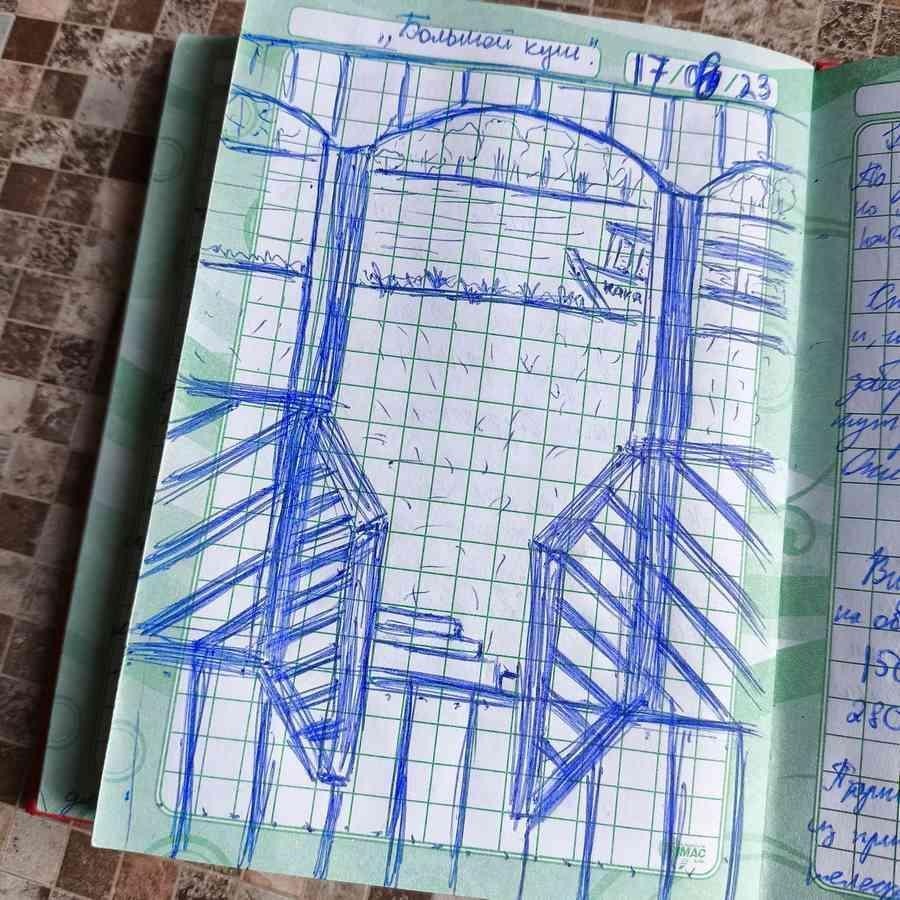
It is Saturday. Young people from the neighbourhood have gathered to play football. Some run barefoot, some use only one trainer for their kicking foot. It is a whole different world! The genre dictated that I should have joined them, but I am much more interested in being a quiet observer. I am not a football fan. I have had enough adventures.
While the boys played football, I chatted with some women. From them I learnt that one of the footballers was a bandit who had stolen a phone from one of them not so long ago. When I asked them why the community could not punish him, they shrugged their shoulders. This is the way of life, a pledge of harmony.
One of the women had a child with six fingers on both hands.
Ebakurau gave me 50 reals despite my objections. In addition, he said he had arranged for a boat to pick me up. It would take me to Coari the next day. How different people are here! Just like on the river, where nothing is neutral, it is the same with people. They are either completely open-minded or… I have seen what happens when they are not, and it is called ‘piracy’.
Much to my delight, they helped me sell my tarafa net. The fishing net had never caught me anything good because of the untimely wet season. It was a good investment anyway – good enough to buy me a ticket to Manaus from Coari. I was offered a better price, but I stuck to the sum I needed.
I asked about the cost of the large wooden boats at the pier. They are about 7-8 metres long and have a tented shelter on the deck. The tiny ‘Lady Kaka Ebakurau’ costs only R$1,500 and its Yamaha motor will cost R$1,200 on top of that. 50,000 R$ would buy me a large boat. I would like to own one someday, but I would choose a sailing boat. I have long dreamed of a yacht and sailing around the world. One day I will. Maybe.
Ebakurau turns 60 in the morning! I thought it was the perfect opportunity to give him my machete which I named Will. I do not think I have mentioned its name before, or it was so long ago that I had time to forget. Such is the formula for my journey: Will + Freedom = my dream comes true. I value my machete very much, but I will not need it at home, and Ebakurau will put it to good use. I have seen him out in the fields harvesting farinha with his old rusty machete.
The evening passed in conversation. Hai dropped by. He is that guy who was running around with the Nike-branded kite. I thought he was only about 16 to 18 years old, but it turns out he is already 25. He insisted that I take 50 reals from him as well, that it was from the bottom of his heart, and he wanted me to have them. How can I thank them for all this? I do not know. I can only write about my deep gratitude.


