Contact
Write to me
If you have a question, an idea, an invitation to speak, or just a few words after reading.
The world is better than they say. I’ll show you.
The world is better than they say. I’ll show you.
The sky was overcast again, so the night was cool. First thing in the morning, I was invited on board to warm myself up with some hot coffee. It was accompanied by a whole breakfast buffet. It was so nice to feel supported rather than threatened by the security agencies! I did not even feel like a stranger among this variety of uniforms. Of course, there were jokes about me being sent by the KGB, but I am used to them. People here still think that Russia is just like the USSR and that we have some ephemeral version of communism. Heh. Indeed, everything is like it should be.
I tried to have a modest breakfast, but my hosts literally stuffed sandwiches and fruit in my pockets, and then we took some photos with the crew on the military boat. In the photos, there were all those who were particularly concerned with my fate. Only Chavez happened to be asleep, unfortunately.
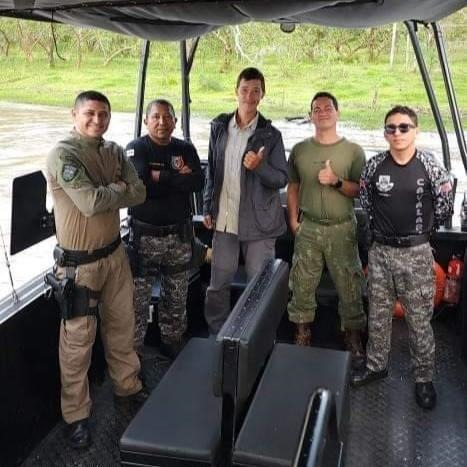
As a farewell gift, the guys brought a huge box and offered me to take it with me. Inside, there were twenty boxes of dry military rations! I was grateful for this generosity, but I took only a couple of packs to try, and politely declined the rest. I am not running out of food; I will catch fish if necessary. Now I know the way.
The people present assured me for the umpteenth time that the stretch of the river to Manaus was safe, that the worst was over. Now, they said, I could relax and just follow the current. I could not be happier at the news! My anxiety had been wearing me out for the last few days.
I say goodbye and leave. I get into the channel in a crosswind – it is stormy again. I look back and see my new acquaintances standing on the pontoon, waving at me. There is a Russian proverb that when you arrive you are judged by your clothes and when you leave you are judged by your heart. This is true.
I cross the river from bank to bank, high waves roll in one after another, but inside me there is such harmony and calmness that everything seems bearable. My hands are holding the oar tightly. At some point I even take a soft biscuit out of my pocket and chew with gusto as I watch the waves crash against the bow of my canoe. I have everything under control. There are only 450 kilometres to the finish line! It is a cakewalk!
I had to reapply engine oil on my feet, as I could not keep them completely dry, so my skin was starting to peel off again. It is quite unpleasant.
I opened one of the dry rations called ‘Cellier Alimentes R3 12horas’. In the kit I found a 120ml gel igniter, a metal stove, matches, 6 Clorin water purifying pills, 2 disinfectant wipes, and a spoon. The meal included various jams and crackers, and the top of culinary art, a true delicacy: rice with mushrooms and meat. I was beyond joy and celebrated the feeling with some guarana jam. Even the sky seemed to brighten. I could confidently state: hunger was defeated for the day.
I was travelling along the central riverbed when suddenly I noticed behind me a huge EPIC GAS ocean liner with 4 gas tanks. It was an unbelievable giant!
The most interesting thing happened after that, of course. I gave way to it and started waiting for a wave just a hundred metres off its course. I could have raked for the bank beforehand, but that would have been a huge mistake. And there it was, the wave.
I decided to do what surfers do. I turned the bow of my canoe at the angle of 45 degrees to the wave to avoid being driven under the wave but to cut it diagonally, and I picked up speed. My boat stood on the wave. It was lifted at least 3 metres up! Then I felt some kind of wild euphoria. I had known I would probably enjoy surfing, but I had not known that I would enjoy it that much. Then came another wave, and another one. Sadly, I watched the river calm down. With horror, I looked at the bank, where the huge mass of water was washing away everything in its path. I would not want to camp there for the night.
No sooner had I recovered from the experience than I noticed a seven-metre-long canoe with a motor about 200 metres away. It was running parallel to me and was heavily loaded with large bundles of bananas. I decided then that these were farmers and that there was nothing to worry about.
Suddenly, the boat turned its bow sharply towards me and began to pick up speed, and one of the two men on board began rummaging around in the bow compartment. Experience immediately told me that it was time to brace for an attack. I had seen this sort of thing before.
I moved to the bow of the canoe so I could be clearly seen and waited for the encounter. Despite my attempt to slow down, the boat hit my bulwark at speed, breaking it. The man started shouting something, waving a big gun in his hands, and I raised my hands. I surrender.
When the attackers were convinced that I was completely calm and presented no danger, they began to ask questions. They wanted to know if I had any drugs or gold on board. I explained that I had nothing of the sort, and that only two days ago I had already been robbed by pirates, that I had no smartphone, no money, and nothing of value. I pointed to the torn tent where the solar panel used to be. I did not repair it, so that I would have some evidence for this kind of occasion.
The man with the gun examined my canoe, asked some questions, ordered me to open my first aid kit (it lay in plain sight as I was treating a festering finger), and to show him my sunglasses. I explained that they were worthless, and that I carried them on my hat to protect my eyes from wind.
When he was sure I had no valuables, he lowered his gun and said something along the lines of: ‘We are not pirates! My name is Selvio, and this is Felipe. We thought you were a Peruvian carrying drugs, and we do not like Peruvians, we can even do them in! Sorry, do not be angry!’
I was taken aback by this turn of events. I pointed out once again that I was from Russia, as the note on the tent said. I assured them that I understood their dislike of drug traffickers, that they were not pirates, but just concerned residents of the river. I assured them that nothing terrible had happened and that I would fix the boat somehow. It was not critical damage at all.
Then they started the engine and, barely hiding their weapons, wished for God to protect me. That was hilarious. Ahead of me was a fork in the river on the map. An island divided the river in two, so I decided to ask them which part of the river was safer. They told me it was the left part, and there were real pirates on the right bank of the river. Well, I said that I believed them.
They left me alone with my thoughts, and I kept exclaiming in my mind: ‘They are not pirates, but what was the gun for?! Why did they have to ram my boat? What else shall I expect? What kind gold could I have? It is bright daylight! It is the middle of the river! Damn pirates…. I have run out of words!’
Maybe I should not push my luck. Every minute on the river is a risk now. There are still about 440 kilometres to go, which means at least 90 hours on the water. 5,400 minutes. How many pirates can one come across during that time? Time stretches on endlessly. I literally feel like a target is painted on my back, and tomorrow is Saturday. There will be next to no one on the river on Saturday. There will be no one to help me.
I tried to relax and calm down my racing thoughts, so I lay down in the boat. Suddenly I heard something like: ‘Olha! Os piratas gringos mataram novamente! O barco está vazio.’ It means this: ‘Look! The pirates have killed a gringo again! The boat is floating empty.’ I had to look out and wave my hand to stop them from checking out my boat. For the last 800 kilometres, I felt like prey that was regularly wanted. In Peru people were just afraid and avoided me, but in Brazil it was completely different.
I do not know what to do. I have many unpleasant thoughts and there is nothing I could replace them with. They rise to the forefront of my mind as I live through the day. I cannot lie down, as someone might think I am dead and go get my boat. But I am not dead yet. And I do not plan to die! I still have a story to tell.
The sky is overcast, but I can clearly see that the sun is starting to set. There is another fork in the river ahead, and without GPS it is not easy to know where I should go next. I pull over. A boat passes by with three guys who do not look particularly friendly. They dock on the bank, hesitate, point at me. And then two of them come towards me. I figured they were residents of the community, contemplating helping me out in some way.
Before I can ask a question, they ask me rudely, ‘Got any drugs?’ The guy has a tattooed face and a stern but youthful look that reflects a certain recklessness. All that is missing is a gun in his hand. Well, what if they are worried about their community and are trying to scare me away? I reply that I have nothing, that I was searched by the police just yesterday, that they had even given me a military ration as a present. I thought they were inquiring for their own safety, but the next question they asked me was whether I had a phone. So, the last piece of the puzzle fell into its place – these are not good Samaritans. They are pirates, for Christ’s sake.
I explained that I had already been robbed upstream, that I had nothing of value. The interest in their eyes clearly faded. I took the opportunity to ask them which way I should go. Should I steer to the left or to the right? Then these guys advised me to lead my boat to the right and around the island. They said there was a wasteland on the left bank with no villages, so people often get robbed there. After gracing me with this valuable advice, they left.
I did not believe them, and at the first opportunity I decided to stop by one of the local communities downstream to ask for a place to stay or at least to ask some questions.
I led my boat downstream along the bank, and there are many houses near the water. I wave to the people on the bank and there is no response. They ignore me completely. I have seen stretches of river like this before. It is like a horror film. Then I dock and ask them to answer just one question: where should I go next? People answer that the inhabited bank is the left one, while the right bank is a wasteland. That is what I thought. That is exactly where those guys wanted to direct me. There is no doubt about their intentions now.
It is getting dark fast. There is another settlement ahead. I start a conversation with the people, first asking about which way is safer to navigate. They recommend the left bank, of course. On the right, they say, I might be killed. Then I ask for permission to spend the night here on the bank, as the sun is almost down. The people call for the headman who chases me away in a rude manner. I try to explain myself. He is rude again. I am told to get out of here. There is no explanation, nothing. It is all the more ironic because behind them stands a small white-washed church. What decent Christians they are. I am torn up inside with frustration. I leave and say goodbye with a very cruel phrase: ‘You say that it is dangerous to for me travel in the dark, that I could be killed, and yet you send me away. All right, I will go, but know that if I am killed, it will be on your conscience and on the conscience of your community!’ With those words, I lead my boat downstream, with four pairs of eyes seeing me off.
I realise it was wrong of me, for these people are afraid for their lives too, but I could not help it. I am too hurt by their inhumanity. My eyes are full of tears – against my will. I am not crying because I pity myself or fear for my life, no. The death of a human being is part of a natural cycle, the death of humanity in people’s hearts is scarier. And here it unfolded before my eyes. The last time I experienced similar feelings was in 2021 at a peaceful protest in St. Petersburg. There, in plain sight, tough men without uniforms were beating up innocent people.
There is less than an hour before sunset. I keep paddling and thinking that I should leave everything and spend the night right in the jungle, taking only the essentials with me. The guys from that last boat will probably come searching for me at night. Let them take me!
Absorbed in my thoughts, I suddenly notice a guy on the bank. He waves at me to come over. I show him that I need to go downstream faster to find a safe place to sleep. Then he gestures to the island ahead, then points at me and puts his finger to his neck, then brushes it: ‘You will be killed there.’
He seems to know what he is talking about. This is no longer the usual ‘downriver is dangerous’ warning. I think I should dock. I approach the bank, wanting to find out what the guy meant. I cherish the hope that I will be allowed to stay here for the night, but I do not say it, so as not to be rejected right away, as in the last few communities. The sun is almost down.
I meet Christian. Our conversation lasts for a while. Other residents of the community come to the dock, and I can feel their fear. They are not afraid for themselves, no. They are afraid for me, not understanding how I managed to get this far. They explain to me that there are as many as four separate crews of pirates operating near the island, they tell me about their equipment and their weapons, how they track their prey with binoculars and fire long-range rifles without any conversation. They take everything of value afterwards. The locals are so knowledgeable that I am getting suspicious.
I cannot go any further. It is only 400 kilometres to Manaus, not much, but for the last 63 days it seems that I have been testing my luck and putting my life on the line every day, hoping to win wild money. I did not notice that I had already won a lot, and now I risked losing it all in one moment of stubbornness. Thinking about it, I made the decision to give up my idea of travelling down the river until the end. This is not a case where kilometres are important, and even if they are, I have left at least 2800 behind me. Now I am hesitating in the conversation, but not because I am hesitant whether I should go on or not. No, now it is important to explain that I am not some drug mule and I am not a danger to the locals – or I will be chased away again.
Seeing my doubts and demonstrating his sincere concern, Christian rudely suggested that I should paddle on and die there unless I believe them. He waved his hand and walked away, leaving me behind.
By this time at least twenty people, from children to old men, had gathered on the improvised pontoon made of planks. One man stood out: he was a grey-haired man with a squint in one eye. He kept his words to himself. Every now and then children ran up to him and said something. I decided that he was the headman of the community. Indeed, he was. He came up to me, said hello, and invited me in without any questions. It felt like I was being rescued.
I was taken to the village – to one of the houses where, as it turned out, the headman himself lived. His name was Ebakurau. He looked to be about 60 years old, and his squint gave the impression that he was very cunning, but in fact he was a sincere wise old man who was loved and respected by everyone around him.
At the house I became more closely acquainted with several of the residents of the community. These included a young good-natured chap called Hai, and a dark-skinned José, who herself resembled a bandit. That first impression intensified greatly when in the evening I said something like, ‘How do you know so much about the pirates around here?’, and she jokingly replied, ‘We’re pirates ourselves, ha!’ She was quickly hushed up, but the words lingered in my memory.
I was treated to a hearty meal of fried arapaima (the locals call it pirarucu or paiche), the very fossil fish that breathes oxygen and can reach fantastic size of up to 4 metres in length in local lakes.
After dinner I was allowed to spend the night in one of the rooms. This is my first night without my ‘Libertad’. I am afraid that this time it is my only choice. I agreed and went into a room with a hammock. I did not use it; I was too used to sleeping on boards, so I set up my bed on the floor.
Despite my fatigue and a busy day, I could not fall asleep quickly. I stared at the ceiling and looked at the doorknob now and then. What would I do if it were locked in the morning? How little a human life is worth here. A foreigner’s life is doubly so. How easy it is to kill a person! There will be no persecution, no investigation at all. Nobody would find the body, and sometimes they will not even look for it. It sounds terrible, but it makes these acts of gratuitous kindness even more valuable.
16 June, ~66 (2819) km covered.


